Best overall for broad, sound concrete: a gas pressure washer with a matched surface cleaner. Best for small, lightly soiled driveways: an electric pressure washer. Best for edges: an adjustable-pressure washer with a fan-tip wand. This 2026 guide compares equipment setups, explains their limits, and helps you decide whether to clean the driveway yourself or book a service.
- Best pressure washing equipment Denver driveways: a gas washer with a matched surface cleaner for broad, sound concrete.
- Choose an electric pressure washer for smaller areas with light surface dirt, not as a substitute for stain treatment.
- Use a fan-tip wand around edges; keep concentrated spray away from damaged concrete, joints, and garage-door seals.
- Mission GDS provides pressure washing for Denver-area homeowners who prefer a service visit to managing equipment themselves.
Why this matters
A driveway needs more than a machine with a large pressure rating. Water flow, attachment compatibility, concrete condition, and runoff control all affect whether the setup suits your job. More force does not make damaged concrete a better cleaning candidate.
For Denver homeowners planning driveway cleaning in 2026, start with the surface and the work area—not the equipment label. Identify cracks, loose material, oil marks, nearby electrical connections, and the route dirty water will take before choosing a machine.
Mission GDS pressure washing is a service option for Denver-area homeowners who prefer not to operate the equipment themselves. You can review Mission GDS and book online anytime, or call/text (970) 788-2884. The company quotes on site after seeing the job.
What makes the best driveway pressure washing equipment?
Use these criteria to compare a complete setup rather than buying a machine in isolation:
- Surface suitability: The equipment must suit the driveway material and its condition. Exposed aggregate, pavers, coatings, and damaged concrete need different treatment decisions.
- Water flow: Compare the manufacturer's stated flow requirement with your water supply. Pressure alone does not describe cleaning or rinsing capability.
- Attachment compatibility: Match the surface cleaner's pressure, flow, connectors, and nozzle requirements to the washer.
- Control: Choose equipment that lets you follow the surface manufacturer's cleaning instructions without relying on a concentrated jet.
- Site access: Consider hose reach, outdoor electrical access, obstacles, drainage, and where a gas machine can operate safely.
- Operating responsibility: Include hose management, eye protection, equipment checks, wastewater handling, and shutdown—not just the cleaning pass.
For a 2026 equipment shortlist, reject any combination whose manuals do not establish compatibility. A connector that fits is not proof that a washer and attachment work together correctly.
Driveway cleaning equipment at a glance
These are equipment configurations, not claims about individual models. The ranking separates broad-area cleaning, compact jobs, detail work, and pretreatment; some configurations complement one another.
| Equipment setup | Best for | Standout feature | Key limitation |
|---|---|---|---|
| Gas pressure washer with matched surface cleaner | Broad, sound concrete driveways | Enclosed rotating spray for the main cleaning area | Requires outdoor engine operation and careful attachment matching |
| Electric pressure washer with suitable accessories | Small driveways with light surface dirt | No gasoline engine to fuel or maintain | Requires safe electrical access and model-specific attachment checks |
| Adjustable-pressure washer with fan-tip wand | Edges, corners, and narrow sections | Direct control around obstacles | Easier to leave uneven cleaning lines across a broad area |
| Detergent-compatible washer with concrete cleaner | Pretreatment of suitable stained concrete | Adds chemistry where water alone is insufficient | Cleaner compatibility, dwell time, and wastewater need separate attention |
1. Gas washer and surface cleaner: best for broad concrete
A gas pressure washer supplies pressurized water, while a compatible surface cleaner directs rotating spray beneath a housing. The combination suits an open driveway where the main task is cleaning a broad, sound concrete surface. Keep a compatible wand available for areas the surface cleaner cannot reach.
Gas washer and surface cleaner pros:
- The surface cleaner housing limits outward spray compared with an exposed wand.
- Rotating spray helps cover the main driveway area systematically.
- The setup does not require an electrical cord for the washer itself.
- A separate wand can handle borders and the final rinse.
Gas washer and surface cleaner cons:
- Engine exhaust requires outdoor operation away from openings and occupied spaces.
- Fuel, engine maintenance, hoses, and attachment checks add preparation.
- A mismatched surface cleaner does not become suitable just because its connector fits.
Best for: Homeowners cleaning a broad concrete driveway that is sound enough for the selected equipment and method.
Check the match before starting
Read both manuals. Confirm that the washer's output falls within the surface cleaner's permitted pressure and flow range, and use the specified connections and nozzles. Do not choose attachment width by appearance alone.
Test an inconspicuous area using the manufacturer's method. Keep the cleaner moving as directed, then inspect the result before treating the rest of the driveway. Stop if the process loosens material or changes the surface texture.
Verdict: Choose this setup for broad, sound concrete; skip it when the attachment match or surface condition is unresolved.
2. Electric washer: best for small, lightly soiled driveways
An electric pressure washer uses an electric motor instead of a gasoline engine. It is a practical configuration when the cleaning area is small, surface dirt is the main problem, and suitable electrical access is available. Its actual cleaning capability depends on the model—not simply on being electric.
Electric pressure washer pros:
- No gasoline engine to fuel or service.
- Suitable for focused cleaning when the model meets the job's requirements.
- Can use approved accessories listed by its manufacturer.
- Lets you approach a small project without managing engine exhaust.
Electric pressure washer cons:
- Electrical connections require protection from water and proper ground-fault protection.
- Cord and hose routing add obstacles around the driveway.
- A surface cleaner must match the specific washer; compatibility is not automatic.
Best for: Smaller driveways with light dirt and safe access to an appropriate electrical supply.
Keep the electrical setup out of the water
Follow the washer's instructions for the outlet, ground-fault protection, and any permitted extension cord. Do not improvise a connection or place plugs where runoff collects. Inspect the cord and equipment before use.
Choose this configuration because it fits your site, not because electric equipment is assumed to be gentle. A pressure washer can damage a surface regardless of its power source. Test the cleaning method before expanding the work area.
Verdict: Choose an electric washer for a suitable small job; skip the setup if safe electrical access is missing.
3. Fan-tip wand: best for edges and awkward sections
A fan-tip wand spreads spray across an angle rather than concentrating it into a single narrow jet. Used with a suitable washer, it gives you access to corners, borders, and strips beside obstacles. It also makes operator technique more important because you control every pass.
Fan-tip wand pros:
- Reaches areas an enclosed surface cleaner cannot cover.
- Supports directed rinsing after the main cleaning pass.
- Offers a choice of manufacturer-approved spray patterns.
- Works around irregular boundaries without forcing a round attachment into them.
Fan-tip wand cons:
- Uneven distance or overlapping passes can leave visible cleaning lines.
- Direct spray can damage vulnerable edges, joints, coatings, and seals.
- Broad-area cleaning requires sustained attention to coverage.
Best for: Driveway edges, corners, and detail work on surfaces approved for the selected cleaning method.
Understand spray angle—not just nozzle color
Common pressure-washer nozzle conventions include a 0-degree concentrated jet, a 25-degree fan, and a 40-degree fan. Those angles describe spray geometry, not a guarantee of safety on your driveway. Confirm the markings and instructions supplied with your own equipment.
Avoid a 0-degree jet for routine driveway washing. A 25-degree or 40-degree fan still requires the correct operating distance, pressure, and surface suitability. Start with the surface and equipment instructions rather than treating a wider angle as permission to spray anything nearby.
Keep spray away from people, pets, electrical equipment, and the garage-door opening. Never use your hand to check a pressurized leak.
Verdict: Choose a fan-tip wand for detail work; skip it as your default for a broad driveway when consistent coverage is the priority.
4. Detergent-compatible setup: best for stain pretreatment
A detergent-compatible washer applies an approved cleaning solution using the method specified by its manufacturer. A cleaner labeled for the driveway material can address contamination that water alone does not remove. Pretreatment is an additional step, not a promise that every stain will disappear.
Detergent-compatible setup pros:
- Adds a cleaning method beyond mechanical spray alone.
- Lets you target affected areas before cleaning the whole surface.
- Can separate stain treatment from the main washing pass.
- Provides label instructions for application, dwell time, and rinsing.
Detergent-compatible setup cons:
- Cleaner suitability depends on the surface, surrounding materials, and equipment.
- Deep staining can remain after surface contamination is removed.
- Chemical use adds handling and wastewater responsibilities.
Best for: Suitable stained concrete where the cleaner label supports the intended use.
Match the cleaner to both the surface and washer
Use only chemicals approved for the equipment and the driveway material. Follow the cleaner's dilution, protective equipment, application, dwell, and rinse instructions. Never combine products or run an unapproved chemical through the pump.
Protect nearby plants and finishes according to the label, and plan wastewater handling before applying anything. Check the rules that apply to your property and municipality; do not assume a storm drain is an acceptable disposal route.
Verdict: Choose approved pretreatment when the stain calls for it; skip improvised mixtures and unsupported stain-removal promises.
How these equipment setups are ranked
The 2026 ranking prioritizes surface suitability, compatible attachments, controlled cleaning, site access, and operating responsibility. The gas washer and surface cleaner combination takes the default slot for broad, sound concrete; electric equipment serves smaller, lighter-duty jobs.
The wand and detergent configurations rank as specialist additions. They solve different problems rather than replacing the main setup. No model-specific performance comparison or hands-on test result is claimed here.
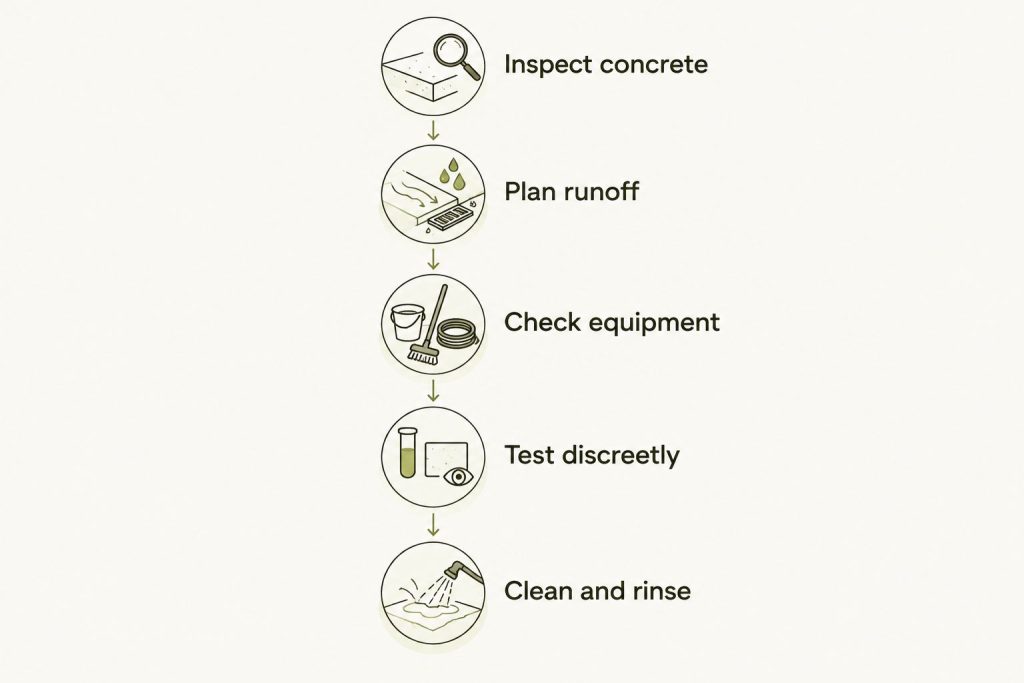
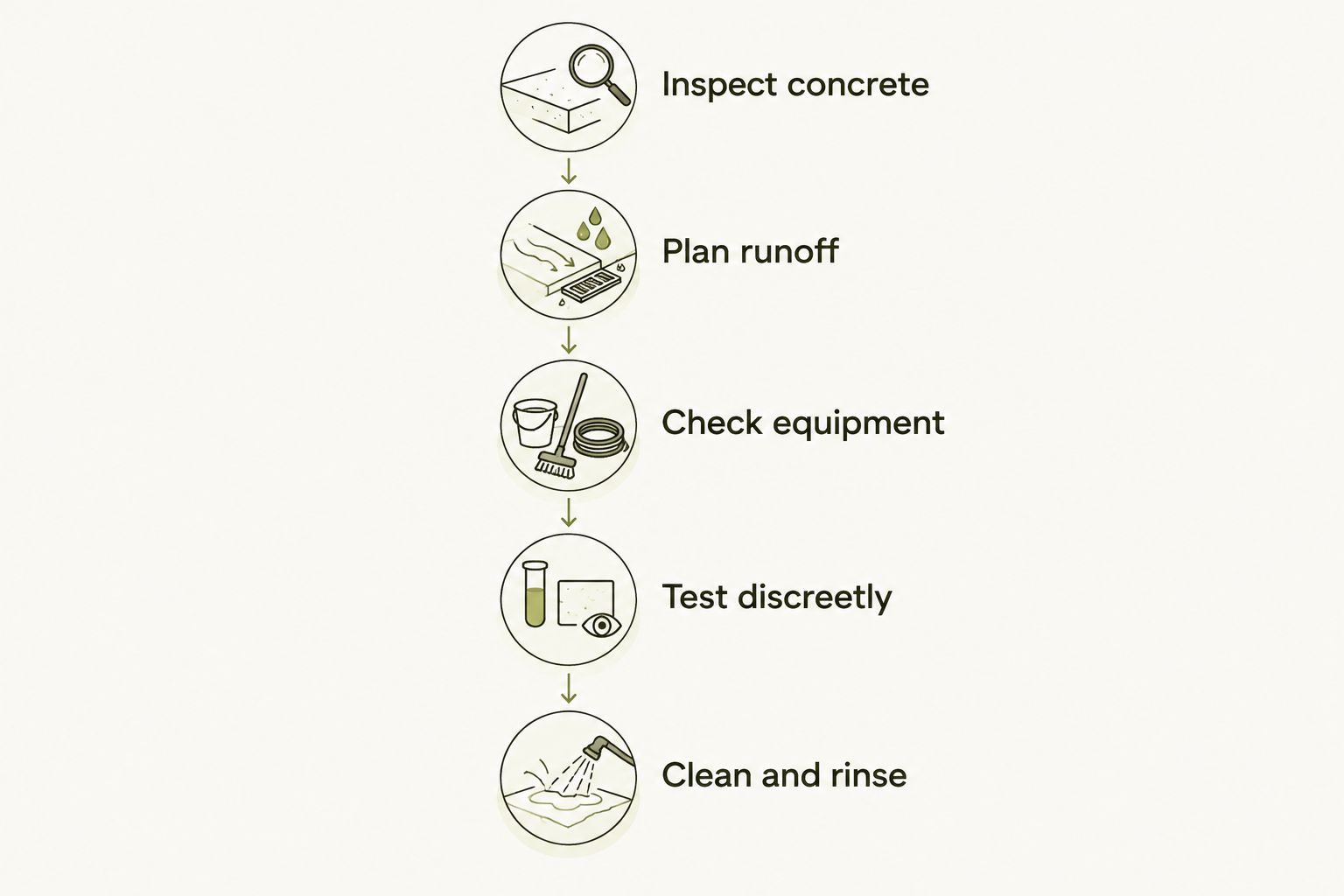
Before you wash: inspect, plan, test
A cleaning pass is the middle of the job. Use this sequence before operating any pressure washer:
- Inspect concrete: Look for loose material, damaged edges, coatings, cracks, and joint problems. Do not pressure-wash a compromised area as a way to repair it.
- Plan runoff: Establish where wash water will travel and how you will handle it under applicable local rules.
- Check equipment: Inspect hoses, connections, electrical components where applicable, and the attachment instructions.
- Test discreetly: Follow the approved method on an inconspicuous patch, then inspect for damage before continuing.
- Clean and rinse: Work systematically, keep the area clear, and follow the shutdown instructions before disconnecting equipment.
At the garage threshold, change the plan rather than forcing the same cleaning pass through a vulnerable area. Avoid directing spray under the door, at seals, or into the opening. Keep equipment and rinse water away from stored items and electrical connections.
Which driveway equipment should you choose?
For a broad, sound concrete driveway in 2026, choose a gas pressure washer with a correctly matched surface cleaner. Add a fan-tip wand for borders and use approved pretreatment only when the surface and stain require it.
Choose an electric washer when a smaller, lightly soiled driveway and safe electrical access make that configuration suitable. If you do not want to manage equipment, chemicals, and wastewater, Mission GDS pressure washing offers a service alternative for Denver-area homeowners. Quote on site after the job is inspected.
Book online anytime at missiongds.com, or call/text (970) 788-2884. Mission accepted.
Book your pressure washing visit
Get an on-site quote after the driveway and cleaning needs are inspected.
FAQ
What’s the best pressure washing equipment for Denver driveways?
A gas pressure washer with a correctly matched surface cleaner is the default choice for broad, sound concrete driveways. Choose equipment based on surface condition, water supply, attachment requirements, and runoff handling—not pressure alone.
Is an electric pressure washer enough for my driveway?
An electric pressure washer suits a smaller, lightly soiled driveway when the model meets the job’s requirements. Safe electrical access and manufacturer-approved accessories are essential.
Do I need a surface cleaner attachment?
A surface cleaner is useful for covering a broad, open concrete area systematically. It does not replace a wand for corners and borders, and its pressure and flow requirements must match the washer.
Which pressure washer nozzle should I use on concrete?
Use the nozzle and operating method approved for your equipment and concrete surface. Common 25-degree and 40-degree fan tips spread the spray, but neither angle guarantees that the selected pressure or distance is safe.
Can pressure washing remove every oil stain?
Pressure washing does not guarantee complete oil-stain removal. A cleaner labeled for the surface can help with treatment, but staining beneath the surface can remain.
Can I run a gas pressure washer inside the garage?
No—operate a gas pressure washer outdoors, away from doors, windows, and vents. Engine exhaust contains carbon monoxide; opening the garage door does not make indoor operation safe.
How do I get a quote for driveway pressure washing?
Mission GDS quotes on site after seeing the driveway and the cleaning needs. Book online anytime at missiongds.com, or call/text (970) 788-2884.
One last thing
A cleaner driveway does not repair damaged concrete. For your 2026 project, stop if the test patch loses material, exposes aggregate unexpectedly, or changes texture. Increasing pressure to chase a remaining mark is the wrong next move—reassess the stain, surface, and method instead.
Related guides
- Best insulated garage doors for Colorado winters
- Best custom garage door designs for Parker homes
- Best garage door openers for Colorado homes