

Best overall: a belt-drive opener for a balanced, standard-track door. Best for overhead clearance: a wall-mount opener. Best for a detached garage: a chain-drive opener. The best garage door openers for Colorado homes in 2026 fit your door, your garage layout and your need for access during an outage—not just a motor rating.
- The best garage door openers for Colorado homes fit the door before adding smart features.
- Choose a belt-drive opener when a bedroom or living space borders the garage.
- Choose a wall-mount opener only after checking the door, shaft and side clearance.
- Choose battery backup when powered garage access during an outage matters.
- Mission GDS garage door services suit Front Range homeowners who need repair or installation support.
Need an opener fixed or replaced now? See our garage door opener repair and installation in Parker.
Why this matters
An opener moves the door. The springs counterbalance its weight. Buying a stronger motor does not fix a broken spring, damaged track or door that binds during travel.
For Colorado homeowners, start with the actual garage: attached or detached, ceiling storage, door construction and alternate entry. Those details narrow the choice faster than a list of connected features. Mission GDS provides garage door repair and installation across Colorado’s Front Range and Denver metro area.
Mission GDS garage door services are best for Front Range homeowners who need help with door repair or installation. An opener replacement should address how the complete door system operates, not leave an existing mechanical problem in place.
What makes the best garage door opener?
Use these criteria for your 2026 purchase. Check the door first; compare convenience features second.
- Door compatibility: The opener must support the door’s construction, dimensions, track arrangement and required travel. A wall-mount model also needs a compatible torsion-shaft setup.
- Noise control: A belt drive avoids chain-on-sprocket noise, but rollers, hinges and loose hardware still contribute to what you hear inside the house.
- Installation clearance: Ceiling-mounted openers need space for the motor and rail. Wall-mount openers need suitable clearance beside the door’s torsion shaft.
- Outage access: Battery backup provides powered operation when household electricity fails. Without backup, understand the manual-release procedure before you need it.
- Safety and maintenance: Accessible controls, working entrapment protection and clear testing instructions matter more than another app feature.
Do not confuse the drive type with the feature package. Belt-drive and chain-drive openers can have different controls, connectivity and backup arrangements. Check the specific model’s documentation rather than assuming every opener in a category includes the same equipment.
Best garage door openers at a glance
These are ranked configurations, not individual product models. Battery backup is a feature that can overlap with other choices; it earns its own slot because outage access is a separate buying decision.
| Rank and option | Best for | Standout feature | Key limitation |
|---|---|---|---|
| 1. Belt-drive opener | Attached garages near living space | Belt-driven movement without chain-on-sprocket noise | Cannot silence worn rollers, hinges or an unbalanced door |
| 2. Wall-mount opener | Garages where overhead rail clearance matters | Motor mounts beside the torsion shaft | Requires a compatible door system and side clearance |
| 3. Chain-drive opener | Detached garages where drive noise is less important | Familiar chain-and-rail drive arrangement | Chain movement adds noise and requires manufacturer-specified care |
| 4. Battery-backup-equipped opener | Homes that need powered access during outages | Operates from a backup battery when mains power fails | Battery needs maintenance and eventual replacement |
The default is the belt-drive opener. Change that choice when your garage layout or access needs give another configuration a clear job to do.
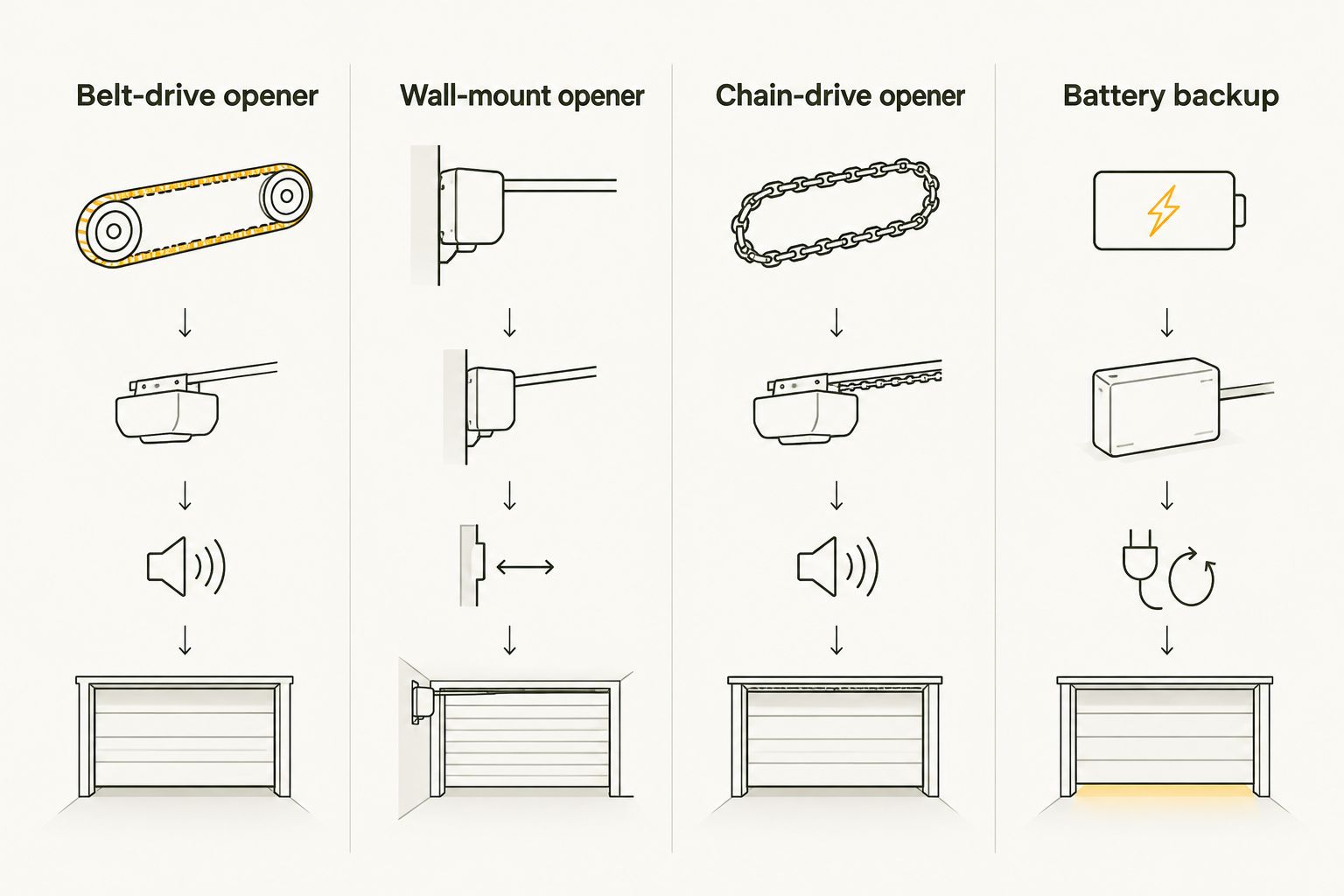
1. Belt-drive opener: best for attached garages near living space
A belt-drive opener moves the door through a rail using a belt rather than a metal chain. It is the strongest default when a bedroom, office or living area borders the garage. Removing chain-on-sprocket noise helps, but the door itself still needs to run smoothly.
Before replacing a noisy opener, identify the noise. A squealing roller, rattling hinge or scraping door section will not disappear because you changed the drive. Ask the installer to separate opener noise from door noise.
Belt-drive opener pros:
- Avoids the metal chain’s drive noise.
- Fits the familiar ceiling-mounted rail arrangement.
- Makes sense when household noise is a buying priority.
- Lets you evaluate backup power and controls separately from the drive choice.
Belt-drive opener cons:
- The rail and motor occupy overhead space.
- Worn door hardware can remain noisy after replacement.
- A belt drive does not establish the model’s suitability for your particular door.
Best for: An attached garage with a compatible standard-track door and nearby living space.
For a 2026 replacement, request the exact model information and installation requirements before approving the work. Confirm that the quote addresses the door’s condition as well as the opener.
Verdict: Buy a belt-drive opener when quieter drive operation is your main priority and the door is compatible.
2. Wall-mount opener: best for freeing overhead rail space
A wall-mount opener mounts beside the door and turns a compatible torsion shaft. It removes the conventional opener rail from the center of the ceiling. That makes it a useful choice when the rail conflicts with overhead storage or another planned use of the garage.
Fit comes first. The shaft, track geometry, door balance and side clearance all matter. A wall-mount opener is not a universal conversion for every garage door.
Wall-mount opener pros:
- Removes the conventional ceiling-mounted opener rail.
- Keeps the opener motor beside the door.
- Addresses a specific layout problem rather than adding another feature.
- Leaves the center ceiling area clear of the opener’s rail assembly.
Wall-mount opener cons:
- Requires a compatible torsion-shaft door system.
- Needs suitable mounting space beside the shaft.
- Does not remove the door tracks or the space occupied by the open door.
Best for: A compatible garage where the conventional opener rail interferes with how you use the ceiling area.
Be precise about the goal. Removing an opener rail is not the same as converting the door to high-lift tracks, and it does not make the open door disappear. Have the installer explain which components remain overhead.
Verdict: Buy a wall-mount opener after compatibility is confirmed; skip it when ceiling clearance is not a real problem.
3. Chain-drive opener: best for detached garages
A chain-drive opener uses a metal chain to move a trolley along the rail. It is a practical configuration when the garage stands apart from living space and drive noise is not your deciding factor. The fit and condition of the door still control the buying decision.
Do not treat a chain as proof that an opener can handle any door. The model’s door requirements matter, and the springs must still do their counterbalancing job.
Chain-drive opener pros:
- Uses a familiar chain-and-rail arrangement.
- Suits a detached garage where household noise is less relevant.
- Keeps the decision focused on door compatibility and useful features.
Chain-drive opener cons:
- Chain movement creates mechanical noise.
- The rail and motor occupy overhead space.
- Chain adjustment and care must follow the manufacturer’s instructions.
Best for: A detached garage with a compatible door where a quieter drive offers little practical benefit.
A chain-drive opener is not maintenance-free. Do not tighten a loose-looking chain by guesswork or apply lubricant without checking the manual. Incorrect adjustment can create a new problem instead of solving the original one.
Verdict: Buy a chain-drive opener when drive noise is secondary; skip it when the garage borders noise-sensitive rooms.
4. Battery-backup-equipped opener: best for outage access
A battery-backup-equipped opener supplies power from a battery when household electricity is unavailable. Backup power is separate from the drive arrangement, so evaluate it alongside the belt-drive, chain-drive or wall-mount configuration you select. Confirm that the exact model includes the backup equipment you expect.
This feature matters most when powered garage access is part of your household’s access plan. It does not fix a jammed door, broken spring or blocked safety sensor.
Battery-backup-equipped opener pros:
- Provides powered operation during a mains-power interruption.
- Reduces dependence on manual door operation during an outage.
- Lets you plan access around an actual household need.
Battery-backup-equipped opener cons:
- The battery requires checking and eventual replacement.
- Available operation depends on the model, battery condition and use.
- Backup power cannot overcome a mechanical door failure.
Best for: A household that needs powered garage access when electricity fails.
For your 2026 purchase, read the backup-operation instructions rather than assuming every control or connected feature works normally during an outage. Keep an alternate entry plan. Test the backup function using the manufacturer’s procedure.
Verdict: Buy battery backup when outage access matters; skip choosing it solely for an app or feature badge.
How these opener choices are ranked
The ranking prioritizes door fit, noise, installation clearance, outage access and maintenance. Belt drive takes the default slot because it addresses a clear concern in attached garages without changing the conventional rail layout. Wall mount ranks next for a distinct clearance problem; chain drive suits detached garages; battery backup addresses access rather than drive mechanics.
This is a configuration guide, not a claim that one motor brand outperforms another. Choose the arrangement first, then check the exact model against the door and installation requirements.
Check the door before replacing the opener
A replacement opener should not conceal a door problem. Give Mission GDS the symptoms you can observe safely: scraping, uneven movement, unusual noise or a door that stops during travel. Keep people clear of a damaged or partly open door.
- Stop repeated cycling: Do not keep pressing the control to force a stuck door through its travel.
- Check the doorway: Look for an obvious obstruction without reaching into tracks or moving hardware.
- Leave springs alone: Springs and related hardware store energy. Do not loosen brackets, unwind springs or attempt a replacement yourself.
- Explain the goal: Tell the installer whether you need quieter operation, overhead clearance or outage access.
If the door is open, unstable or has a suspected broken spring, do not pull the emergency release to experiment. A poorly counterbalanced door can fall. Follow the manufacturer’s instructions and get professional help with the mechanical fault.
Safety checks belong in the installation
For a 2026 installation, have the installer demonstrate the safety controls and leave the model’s instructions accessible. The U.S. Consumer Product Safety Commission’s garage-door safety guidance calls for regular checks of automatic reversal; use the manufacturer’s procedure for the installed opener.
A common reversal test uses a nominal 2-inch-by-4-inch board laid flat, which presents an actual height of about 1.5 inches. The door should reverse when it contacts the test object. Follow the manual, keep people out of the opening and stop using automatic operation if the test fails.
Photoelectric safety sensors are typically installed no higher than 6 inches above the floor, following the opener’s requirements. Keep the beam path clear. Do not bypass the sensors to make the door close.
Ask for a demonstration of the emergency release with the door safely closed. Everyone who needs garage access should understand the procedure before an outage—not discover it with the car trapped inside.
Which garage door opener should you choose?
Choose a belt-drive opener for a compatible attached garage unless another requirement changes the answer. Choose wall mount for a verified overhead-clearance problem, chain drive for a detached garage where noise is secondary, and battery backup for powered outage access.
Your final 2026 decision should name the exact opener model, confirm door compatibility and explain what the installation includes. A feature list is not an installation plan. Fix an unsafe or unbalanced door before asking a new motor to move it.
FAQ
What are the best garage door openers for Colorado homes?
A belt-drive opener is the default choice for a compatible attached garage near living space. Choose wall mount for overhead rail clearance, chain drive for a detached garage, and battery backup when powered outage access matters.
Is a belt-drive opener better than a chain-drive opener?
A belt-drive opener is better when reducing drive noise is your priority. A chain-drive opener suits a detached garage where noise is less important; neither choice fixes an unbalanced door.
Will a wall-mount opener work on my garage door?
A wall-mount opener requires a compatible torsion-shaft door system and suitable mounting clearance. Have the installer check the shaft, track arrangement and door balance before choosing the opener.
Do I need battery backup for my garage door opener?
Choose battery backup if you need powered garage access during an electricity outage. Keep an alternate entry plan and follow the manufacturer’s battery-testing and replacement instructions.
Will a stronger opener fix a heavy garage door?
A stronger opener does not fix a broken spring or an improperly balanced door. Have the door’s mechanical condition checked before replacing the motor.
Does a smart opener need Wi-Fi to open the door?
App-based control generally needs the connectivity specified by the manufacturer, while local controls depend on the opener’s design. Check the exact model’s instructions for internet outages and power failures; they are different situations.
Should I replace a noisy opener or repair the door?
Identify the source of the noise before replacing the opener. Rollers, hinges, loose hardware and binding tracks can remain noisy even after you install a quieter drive.
One last thing
A quieter opener cannot make a scraping door quiet, and backup power cannot move a door with a failed spring safely. Ask Mission GDS to address the door’s condition before settling on the opener. Get the moving system right. Then choose the convenience features.
Related guides