
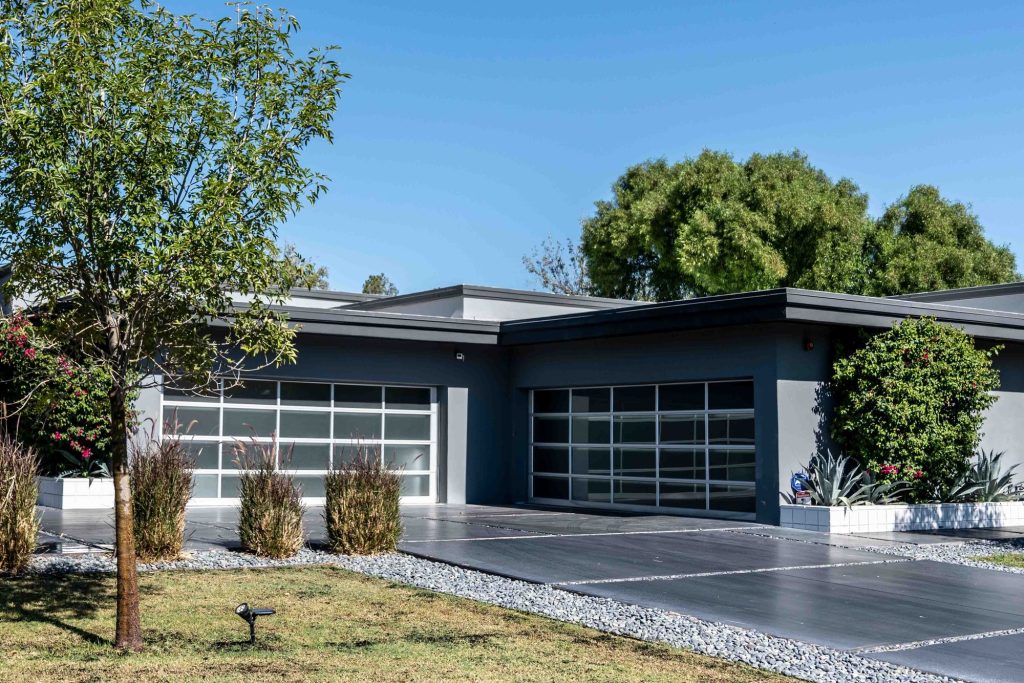
Best overall: insulated sectional doors. Best for tight overhead space: rolling steel doors. Best for customer-facing bays: full-view sectional doors. For Parker businesses comparing commercial garage doors in 2026, the right choice depends on what moves through the opening, how often it opens, and what happens behind it.
- Best commercial garage doors Parker CO: insulated sectional doors are the default for enclosed, occupied service bays.
- Rolling steel doors suit openings where sectional tracks would compete with overhead equipment.
- Full-view sectional doors suit customer-facing spaces; high-speed doors suit frequent traffic.
- Mission GDS installs and services commercial overhead doors for Parker-area businesses, along with residential garage doors across the Denver metro.
Why this matters
A garage door is part of your building’s workflow. The wrong design blocks equipment, interrupts traffic, or leaves an occupied bay exposed whenever it opens. Start with the opening’s job, not a catalog photo.
Mission GDS is a veteran-owned garage door company serving Parker, Castle Rock, Elbert County and the Denver metro. Mission GDS installs and services commercial overhead doors for Parker-area businesses, as well as residential garage doors. Tell us what the opening has to do, and we will check it on site before recommending a door.
This 2026 guide ranks door types by use case rather than manufacturers. Choose the design first. Then compare proposals for the same opening, operating requirements, and installation scope.
What makes the best commercial garage door?
Use these criteria before comparing doors. A strong proposal answers each one for your building, not just for the door panel.
- Opening fit: Measure the opening, headroom, side room, and available track space. Include nearby lights, pipes, sprinklers, and equipment.
- Traffic pattern: Separate occasional vehicle access from repeated opening throughout the workday. Specify expected cycles and the direction of travel.
- Indoor conditions: Decide whether the space needs insulation, daylight, ventilation, or separation from another work area.
- Security purpose: Identify what the door must keep out. A ventilated grille and a solid exterior door solve different problems.
- Safe operation: Match controls and protective devices to pedestrians, vehicles, visibility, and the operator’s instructions.
- Serviceability: Ask how technicians access the door, which components require maintenance, and how replacement parts are obtained.
For your 2026 purchase, write those requirements into the request for a proposal. Otherwise, two installers can quote different systems that look similar but solve different problems.
Commercial garage doors at a glance
| Door type | Best for | Standout feature | Key limitation |
|---|---|---|---|
| Insulated sectional door | Enclosed, occupied service bays | Insulated panels with multiple track configurations | Tracks and an open door occupy overhead space |
| Rolling steel door | Openings with overhead obstructions | Curtain coils above the opening | Requires room for the coil and its supporting assembly |
| Full-view sectional door | Customer-facing bays and showrooms | Glazing brings daylight and visibility | Thermal performance depends on the complete assembly |
| High-speed door | Frequent traffic between work areas | Faster opening and closing than conventional slow-cycle designs | Suitability depends on traffic, exposure, and door construction |
| Rolling grille | Access control with ventilation | Open construction preserves airflow and sightlines | Does not provide weather separation |
The table is a decision tree, not a claim that one door fits every business. An occupied repair bay and an interior warehouse passage need different answers.
1. Insulated sectional doors: best for occupied service bays
Insulated sectional doors use connected panels that travel along tracks. The door typically moves overhead when open, although track arrangements vary with the building. Insulated panels make this category a practical starting point when the space behind the door is occupied or conditioned.
Choose an insulated sectional door when technicians work inside the bay and vehicles enter periodically. Before selecting the panel construction, confirm where the open door and tracks will sit relative to lifts, storage, lighting, and other equipment.
Insulated sectional door pros:
- Insulated panels support separation between indoor and outdoor conditions.
- Window sections can provide daylight and a view of approaching traffic.
- Track configurations can accommodate different building layouts when sufficient clearance exists.
Insulated sectional door cons:
- Tracks and the raised door consume space above the bay.
- Springs, cables, rollers, and hinges require inspection and maintenance.
- Panel insulation alone does not describe the thermal performance of the complete opening.
Best for: Occupied service bays, workshops, and vehicle-access spaces where insulation matters more than a compact overhead footprint.
Ask for the complete door assembly’s performance information, including glazing and perimeter seals. For a 2026 replacement, also have the installer inspect the existing tracks and support structure rather than assuming they suit the new door.
Verdict: Buy an insulated sectional door for an occupied bay after confirming overhead clearance.
2. Rolling steel doors: best for tight overhead space
Rolling steel doors use interlocking slats that form a curtain. The curtain coils above the opening instead of moving back into the room along horizontal tracks. That changes where the door needs space; it does not eliminate clearance requirements.
Choose a rolling steel door when pipes, equipment, or the building layout make sectional tracks inconvenient. The installer must check the coil area, side guides, mounting surfaces, and access for future service.
Rolling steel door pros:
- Keeps horizontal door tracks out of the room behind the opening.
- Provides a solid curtain for openings that need an enclosed barrier.
- Offers a useful layout alternative when overhead equipment constrains a sectional door.
Rolling steel door cons:
- The coil and supporting assembly need clearance above the opening.
- Insulation and sealing depend on the selected construction, not the category name.
- A damaged curtain or guide can interfere with operation.
Best for: Storage and service openings where horizontal tracks would conflict with the building’s use.
Do not treat a standard rolling steel door as a fire door. If the opening requires a fire-rated assembly, specify that requirement separately and have the proposed assembly checked against the applicable building requirements.
Verdict: Buy a rolling steel door when track clearance is the deciding constraint.
3. Full-view sectional doors: best for customer-facing bays
Full-view sectional doors combine framed sections with substantial glazing. They bring daylight into the space and let people see through the closed door. Their strongest use case is a bay where visibility is part of the building’s function.
Choose a full-view sectional door for a showroom, customer-facing workshop, or another space where a mostly opaque door would block useful light. Treat glass selection, privacy, and indoor comfort as purchasing decisions—not finishing touches.
Full-view sectional door pros:
- Provides daylight while the door stays closed.
- Gives staff and visitors visibility across the opening.
- Suits spaces where the door contributes to the customer-facing environment.
Full-view sectional door cons:
- Glazing can expose equipment and activity to outside view.
- Thermal performance depends on glass, framing, seals, and overall construction.
- Glass and frames need cleaning to preserve visibility.
Best for: Customer-facing bays and showrooms where daylight and sightlines justify the glazing.
In your 2026 specification, identify which areas need clear visibility and which need privacy. Also ask about safety glazing and replacement procedures. A full-view door still needs a suitable track layout and operating system.
Verdict: Buy a full-view sectional door when visibility serves the business; skip it when privacy is essential.
4. High-speed doors: best for frequent traffic
High-speed doors prioritize opening and closing speed. Designs differ in curtain material, rigidity, sealing, impact response, and intended environment. Specify the application before comparing individual systems.
Choose a high-speed door when repeated traffic makes a conventional door an operational bottleneck. Interior separation between work areas is a different assignment from an exterior vehicle opening exposed to weather.
High-speed door pros:
- Reduces the time users wait for a suitable door to open.
- Supports repeated movement between designated work areas.
- Shortens each opening event when the controls and traffic pattern are configured correctly.
High-speed door cons:
- Specialized controls and components require an appropriate service provider.
- Curtain construction must match the exposure and security requirement.
- Fast movement does not replace traffic planning or protective devices.
Best for: Frequently used passages where opening time and separation between areas affect daily work.
Ask the installer to explain activation, pedestrian protection, power-loss behavior, and recovery after an impact. Have the installer match the door’s rated operating duty to your expected use. Speed alone is not a complete specification.
Verdict: Buy a high-speed door when frequent traffic justifies it; hold when access is occasional.
5. Rolling grilles: best for ventilation with access control
Rolling grilles use open construction rather than a solid curtain. They control access while preserving airflow and visibility. That makes them a separate category from insulated or weather-sealed exterior doors.
Choose a rolling grille for an opening where ventilation is intentional and keeping people out is the main purpose. Confirm the surrounding enclosure provides whatever weather separation the building needs.
Rolling grille pros:
- Preserves airflow through the closed opening.
- Maintains sightlines between spaces.
- Separates access control from the need for a solid barrier.
Rolling grille cons:
- Does not keep outdoor air or precipitation out like an enclosed door assembly.
- Leaves the space behind it visible.
- Open construction is unsuitable where a solid separation is required.
Best for: Ventilated access points and interior security openings that do not need weather sealing.
A rolling grille is not a substitute for an insulated service-bay door. If your opening serves both ventilation and enclosure needs, discuss the full arrangement with the installer rather than asking one grille to do both jobs.
Verdict: Buy a rolling grille for ventilated access control; skip it for a conditioned exterior bay.
How these commercial garage doors are ranked
The ranking starts with an occupied, enclosed bay as the default use case. Insulated sectional doors take that slot because their construction addresses indoor separation without making visibility or frequent traffic the primary requirement.
The remaining categories each solve a different constraint: rolling steel for track conflicts, full-view sectional for daylight, high-speed for repeated traffic, and rolling grilles for ventilation. Choose the constraint that matters most, then compare systems within that category.
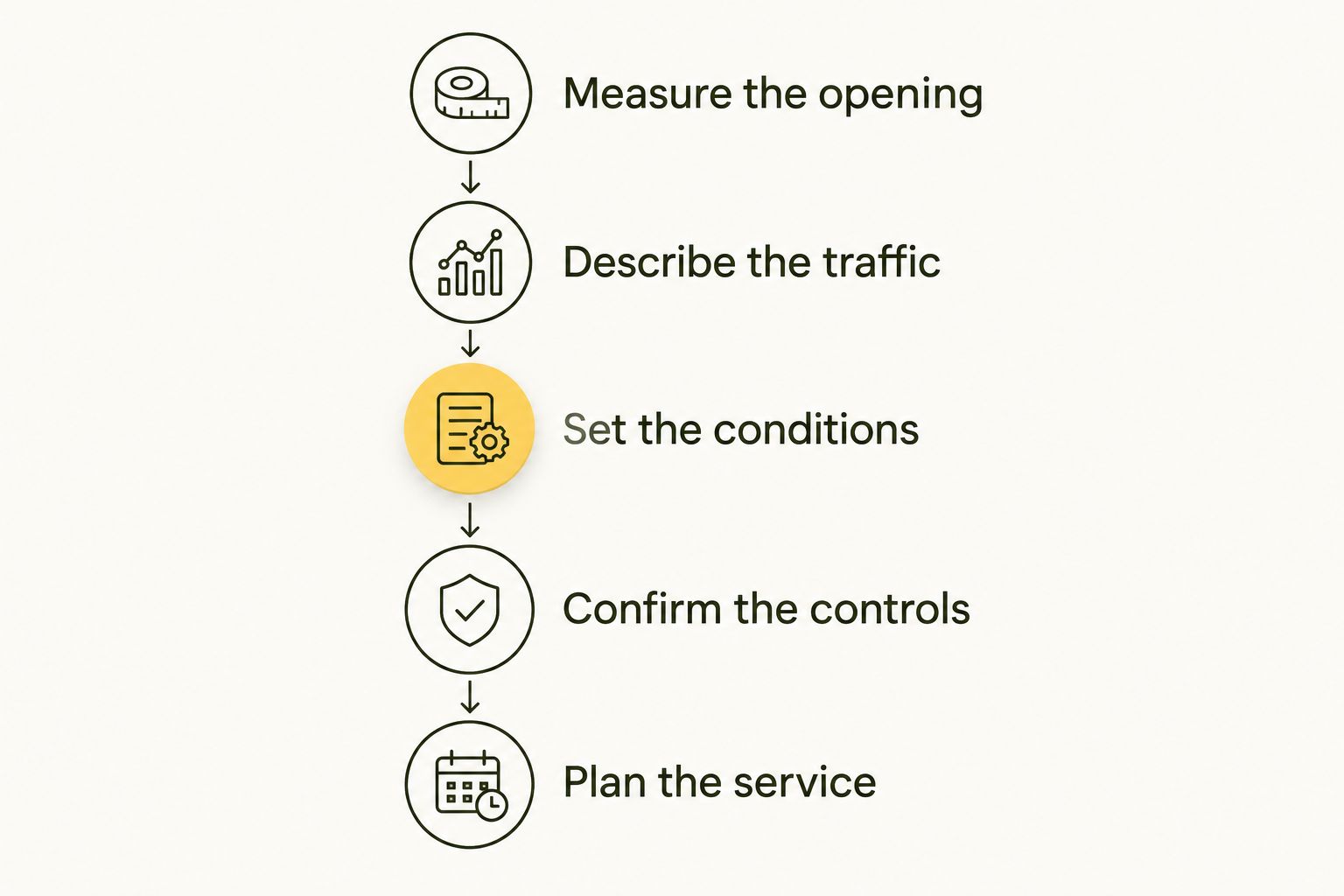
Turn the shortlist into an installation brief
Give each installer the same brief. That makes the proposals easier to compare and keeps important requirements out of verbal-only discussions.
- Measure the opening: Record the opening and surrounding clearances. Have the installer verify them on site.
- Describe the traffic: Identify vehicles, equipment, pedestrians, and how the opening is used during work.
- Set the conditions: Explain insulation, visibility, ventilation, security, and any required rated separation.
- Confirm the controls: Specify who operates the door and how approaching users are detected or protected.
- Plan the service: Ask about inspection access, maintenance instructions, replacement components, and manual operation.
The site visit should resolve conflicts before installation. Do not wait until the door arrives to discover that a track crosses a light fixture or that the operator interferes with equipment.
Which commercial garage door should you choose?
Choose an insulated sectional door for an enclosed, occupied bay unless the building or workflow points elsewhere. That is the clearest default for this 2026 shortlist—not a reason to ignore the opening’s measurements.
Choose rolling steel when horizontal tracks conflict with the space. Choose full-view sectional when daylight and visibility do useful work. Choose high-speed when repeated traffic drives the decision, and choose a rolling grille only when ventilation belongs in the specification.
Mission GDS installs and services commercial overhead doors for Parker-area businesses. We measure the opening, look at how it is used, and quote on site after we see it. Book online anytime at missiongds.com, or call/text (970) 788-2884.
FAQ
What are the best commercial garage doors for Parker, CO businesses?
Insulated sectional doors are the default for enclosed, occupied service bays. Rolling steel, full-view sectional, high-speed doors, and rolling grilles are better fits when space, visibility, traffic, or ventilation takes priority.
Is a rolling steel door better than a sectional door?
A rolling steel door is better when horizontal sectional tracks would conflict with equipment or the building layout. A sectional door is a strong choice for an occupied bay when its tracks and open-door position fit the space.
Do commercial garage doors need insulation?
Insulation is a relevant requirement when the opening serves a conditioned or occupied space. Compare the complete assembly, including glazing and seals, rather than relying on panel insulation alone.
Are full-view garage doors suitable for business premises?
Full-view sectional doors suit business spaces that benefit from daylight and visibility. Check privacy, glazing requirements, thermal performance, and the track layout before choosing one.
When should a business choose a high-speed door?
Choose a high-speed door when repeated traffic makes opening and closing time an operational concern. Match the construction, controls, and rated operating duty to the actual application.
Can a rolling grille keep a commercial garage warm?
A rolling grille does not provide the weather separation of a solid enclosed door. Its open construction serves ventilation and access control, not insulation.
Does Mission GDS install commercial garage doors in Parker?
Yes. Mission GDS installs and services commercial overhead doors for Parker-area businesses, as well as residential garage doors. We quote on site after we see the opening. Book online anytime at missiongds.com, or call/text (970) 788-2884.
What should I ask before ordering a commercial garage door in 2026?
Ask the installer to verify opening dimensions, clearances, traffic requirements, controls, and service access. Require the proposal to identify the complete door and operating system, not just the panel style.
One last thing
The door is not the whole opening. Tracks, guides, mounting surfaces, seals, controls, and the operator determine whether the selected design fits your building and works safely.
Ask for a proposal that names the complete assembly and explains how it fits the site. A familiar door type is no substitute for a checked installation plan. Mission accepted: get the requirements clear before you order.
Related guides